

Two of the main frameworks that shape the assessment of research units and individual researchers in the Netherlands are undergoing a quiet but meaningful shift. Both the new Strategy Evaluation Protocol (SEP) and the Dutch Research Council’s (NWO) evidence-based CV are moving towards indicators based on open research information. What may seem like a subtle change has strategic implications: it embeds openness directly into research evaluation at both the institutional and individual level, marking a significant step forward in the implementation of the Barcelona Declaration on Open Research Information.
Barcelona Declaration
Over the past few decades, universities, research funders and governments have become highly reliant on various forms of research information for policy making and research evaluation. However, much of this information resides in closed, proprietary systems. Not only are these systems costly and non-inclusive, they also lead to decision-making based on non-transparent black box indicators. This situation is difficult to accept in a scientific system committed to openness, transparency, and integrity. The Barcelona Declaration on Open Research Information aims to address this situation by promoting the open availability of research information.
There is considerable support for open research information in the Netherlands. Since the launch of the Barcelona Declaration in 2024, 16 Dutch research organisations have signed the declaration, with signatories taking various concrete steps towards implementation of the commitments. These steps are being prepared partly in a national chapter, where the actions of signatories are being coordinated and streamlined.
Here we report on recent developments to incorporate open research information within two frameworks that significantly influence the evaluation of research units and individual researchers in the Netherlands: the new Strategy Evaluation Protocol (SEP) – in many ways the Dutch equivalent of the UK’s Research Excellence Framework (REF) – and NWO's evidence-based CV format.
SEP's focus on open science principles
In March 2026, Universities of the Netherlands (UNL), the umbrella organisation of Dutch Universities, together with the NWO and the Royal Netherlands Academy of Arts and Sciences (KNAW), published the new SEP for the period 2027-2033. The SEP governs how research units such as faculties or institutes are evaluated in the Netherlands.
The new edition of the SEP builds on the previous edition that covered the period 2021-2027. While the basic philosophy to evaluating a research unit remains unchanged, the new SEP introduces various updates and clarifications, including one that is of major importance for the open research information transition in the Netherlands.
As before, evaluations are based on narrative self-assessments, which can be supported by qualitative and quantitative indicators. What is new is the expectancy that these indicators align with open science principles. As indicated in Appendix D of the new SEP, indicators should align with national and international standards, one of which is the Barcelona Declaration:
whenever possible, indicators should be based on Open Science principles …, such as using data from open sources, in line with the Barcelona Declaration on Open Research Information signed by UNL and NWO. Doing so ensures that indicators are transparent and reproducible. Publication-based indicators can, for instance, be based on data from open sources such as OpenAlex and OpenAIRE rather than proprietary sources such as Web of Science/InCites and Scopus/SciVal.
Until now, many SEP self-evaluations have included publication- and citation-based indicators obtained from closed databases such as Web of Science and Scopus. From 2027 onwards, it is expected that SEP self-evaluations will obtain these indicators from open sources such as OpenAlex and OpenAIRE. As a result, subscribing to Web of Science or Scopus will become less important for Dutch research organisations, while open alternatives will grow in importance.
NWO’s evidence-based CV format
Another significant change in support of open research information in the Netherlands comes from the NWO. NWO is a strong advocate of reforming research assessment. In 2019 it signed the San Francisco Declaration on Research Assessment (DORA) and in 2022 it joined the Coalition for Advancing Research Assessment (CoARA). In line with this, NWO introduced a narrative CV format in 2019, which evolved into the evidence-based CV format. This CV format allows researchers to present a more holistic picture of their academic achievements, more than can often be seen in a traditional academic CVs.
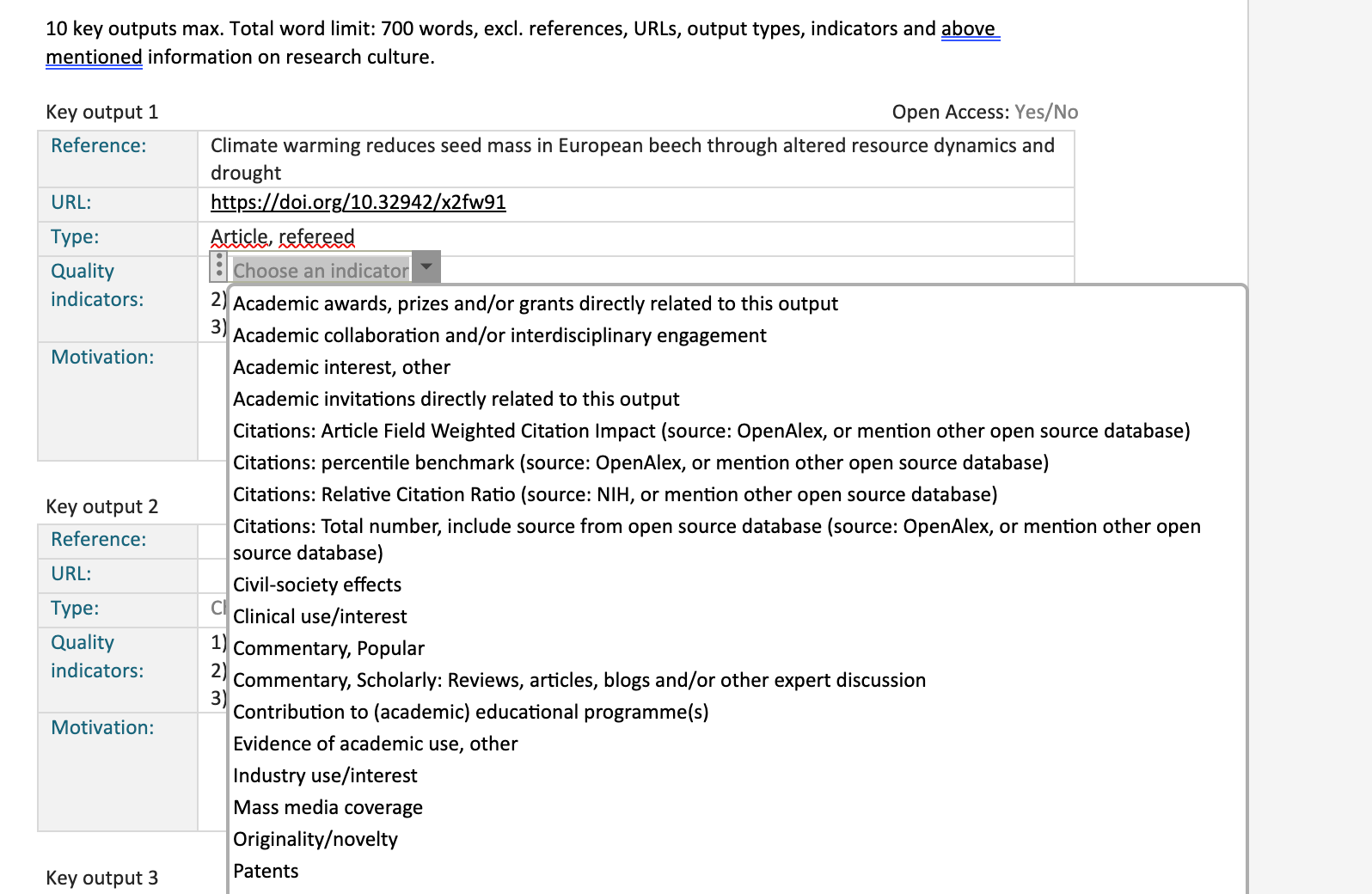
Contrary to what is sometimes suggested, the use of indicators in an evidence-based CV is not prohibited. On the contrary: it is permitted and even encouraged. Researchers are expected to include a maximum of 10 outputs in their evidence-based CV. They are encouraged to choose from a wide range of outputs that go beyond traditional research articles in scientific journals. For each output, researchers must justify its importance, and the use of indicators on the level of single output items is permitted for this purpose.
A variety of citation-based indicators may be used for this purpose, including field-weighted citation impact scores. From this year onwards, NWO states that if citation-based indicators are used, they should preferably be sourced from OpenAlex or another open-source database (see Figure 1). This requirement has been introduced in the Talent Programme and is expected to be rolled out across other NWO funding schemes in due course.
Although this may seem like a small step, it is an essential one for advancing open research information. Citation-based indicators have long been a key factor for research institutions to subscribe to closed databases such as Web of Science or Scopus. These databases were important to support researchers in their grant applications to NWO and other funders. The frequent use of citation-based indicators in funding applications therefore was a significant obstacle to transitioning from closed databases to open alternatives. Now that NWO (and hopefully other funders will follow) recommends obtaining citation-based indicators from open sources in the evidence-based CV, this obstacle is largely addressed.
It is important to note that the recent changes to NWO’s evidence-based CV format should not be interpreted as a blanket endorsement of specific indicators or databases. Critical reflection on indicators and databases will always be necessary. However, for black box indicators based on closed databases this is almost impossible. The transition to open databases is crucial to enable the critical scrutiny of both indicators and the underlying data.
Why alignment matters
The fact that the SEP and NWO’s evidence-based CV format are moving in the same direction, at the same time, sends a powerful signal. Evaluation frameworks at the level of research units (SEP) and individual researchers (evidence-based CVs) are increasingly speaking the same language. This creates a powerful momentum for the open research information movement in the Netherlands. Research institutions and other stakeholders in the Dutch system are all working hard to advance open research information within their own local context. The alignment of evaluation frameworks lowers the barriers for coordinated action, providing research organisations with a significant opportunity to take important next steps in their transition to open research information.
The broader international landscape
The transition to open research information is taking place globally, with different countries and regions each choosing their own priorities, aligned with their local context. Within Europe, for example, the Nordic countries are establishing national open research information infrastructures, while organisations in France are taking important steps in discontinuing their use of closed databases and their participation in non-transparent university rankings (see the announcements by CNRS, Sorbonne University, and University of Lorraine). The Netherlands has now taken a leading role in advancing the use of open research information in the context of research evaluation.
These different national approaches provide valuable opportunities for mutual learning. Many research organisations worldwide have signed the CoARA Agreement on Reforming Research Assessment, committing to the principle of ensuring "independence and transparency of the data, infrastructure and criteria necessary for research assessment”. The recent developments in the Netherlands, combined with ongoing activities in CoARA working groups, offer concrete examples of how this principle can be implemented in practice.
The Netherlands has made a clear commitment to open research information. The next challenge is to implement this commitment consistently, responsibly, and at scale. With key evaluation frameworks now aligned, the Netherlands has laid a strong foundation. The task ahead is to translate this alignment into practice, ensuring that openness strengthens research evaluation. We look forward to the next steps in the journey towards more responsible and more transparent research evaluation practices!
We are grateful to Ana Ranitovic, Darco Jansen, Daphne Kortebeek, and Eline Pronk for feedback on an earlier draft of this post.
Copyright © 2026 Hans de Jonge, Ludo Waltman. Distributed under the terms of the Creative Commons Attribution 4.0 License.